Posts

Showing posts with the label young adult

Classic Australian Children's and YA Novels #5: The Midnight Zoo

Image
Recently I was reading an essay by Clare Bradford on the American Printz Award for young adult fiction. Bradford writes that “the Australian texts that have succeeded in the Printz are Australian but not too Australian”. This statement makes sense in terms of the media coverage of iconic Australian animated series Bluey being adapted for the American market on Disney+ . Changes made include the removal of an episode featuring farting and the deletion of scenes that refer to a vasectomy and which depict a dog sitting on a toilet. There are some aspects of Australian life, language, and culture that are too unfamiliar, or which conflict with the sanitised norms of life as it is depicted on American children’s television. Many of the Australian children’s and YA authors who have succeeded at the highest levels internationally are authors of fantasy, perhaps for this reason. Some of the most recognised works of Australian children’s literature derive from fantasies set in the bush such...

Classic Australian Children's and YA Novels #4: The Gathering

Image
I’ve been reading Australian children’s and young adult fantasy for a grant application, and this week came to Isobelle Carmody’s The Gathering (1993). It was joint winner of the CBCA Book Award for Older Readers in 1994. Unlike awards for adult fiction, which tend to marginalise genre fiction, the CBCA prize lists includes many fantasy titles among its young adult prize winners. As part of the project I’m planning, I’m interested in thinking about how Australian children’s and young adult fantasy replicates familiar tropes and conventions from British and American examples, but also in how it might depart from them. The Gathering struck me as unusual because it depicts an Australian small town that is overcome by forces of darkness. Protagonist Nathanial moves to Cheshunt with his mother and dog, The Tod, after a peripatetic childhood in the wake of his parents’ divorce. He discovers that there is a culture of surveillance surrounding teenagers in the town, and is soon pressured by ...

Transplanted Wonder: A Special Issue of "Marvels & Tales" on Australian Fairy Tale

Image
As an academic, I spend a lot of my research time scouring databases for articles. Marvels & Tales is a journal devoted to fairy tales that I have always admired, and used for both teaching and research. It was an absolute pleasure to co-edit a special issue of the journal on Australian fairy tale with Dr Emma Whatman , whose doctoral work broke new ground in the study of fairy-tale adaptations and postfeminism. In postcolonial contexts, thinking about fairy tale history can be a fraught exercise, particularly when it comes to the way that Aboriginal stories were appropriate by white writers. Nevertheless, our contributors made the job of celebrating, at the same time as critiquing, Australian fairy tales, simple.  Juliet O'Conor, for example, contributes her unparalleled knowledge about Indigenous children's literature to contrast "Aboriginalist" texts such as Katie Langloh Parker's Australian Legendary Tales (1896) with stories written an illustrated by trad...

"Classic" Australian Children's and YA Novels: #1 Tomorrow, When the War Began

Image
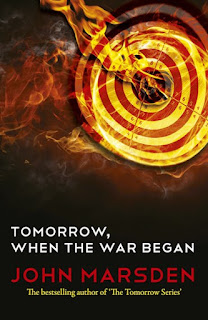
This is the first in an ongoing series of posts about some of the most popular, influential, and enduring Australian children's and YA novels.  Perhaps the most popular and successful Australian young adult novel series is an invasion narrative. John Marsden ’s "The Tomorrow Series" (1993-1999), which began with Tomorrow, When the War Began , has been reprinted more than thirty times with sales of more than three million copies, translated into various languages, and adapted into a film in 2010 and a television series in 2016.  The sequel series, "The Ellie Chronicles", reveals that the force that has invaded Australia is a coalition of South Asian countries seeking the space and natural resources that are limited in their populous region.  Given the origins and evolution of Australian children’s literature throughout the nineteenth and twentieth century, it is unsurprising that an invasion narrative is one of the most notable Australian young adult novels. The ...